Augmented Reality in Healthcare: 20% Diagnostic Improvement by 2026

The integration of Augmented Reality in Healthcare is no longer a distant vision; it is a live catalyst for a 20% surge in diagnostic accuracy by 2026. This shift represents a fundamental upgrade in how U.S. hospitals visualize and treat human pathology.
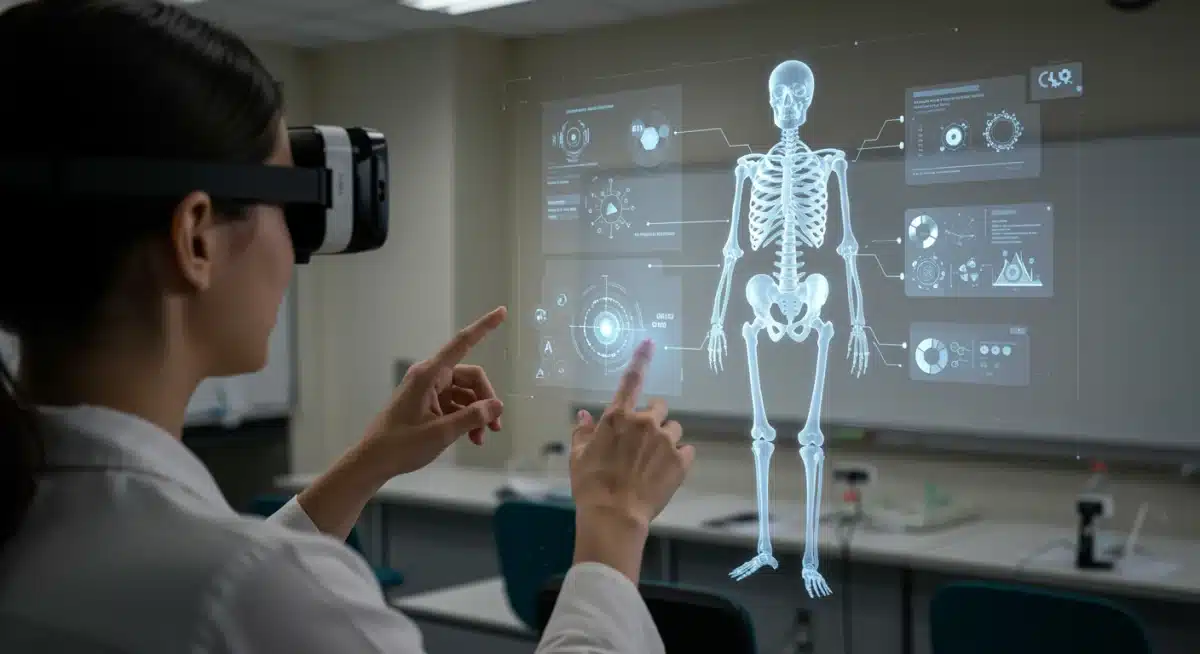
By overlaying high-definition digital data onto a clinician’s real-world view, these immersive tools grant medical teams unprecedented clarity.
This spatial computing approach minimizes human error, turning complex anatomical structures into interactive, transparent maps for faster decision-making.
As the American medical landscape evolves, embracing these mixed-reality innovations is becoming essential for both providers and patients. We are witnessing a pivotal era where digital visualization directly translates into saved lives and streamlined clinical workflows.
The Dawn of AR in Medical Diagnostics
Augmented reality is rapidly transitioning from a niche technology to a fundamental tool within the U.S. healthcare sector. Its core strength lies in enhancing human perception by providing real-time data overlays, which is particularly critical in diagnostic processes.
This integration is not just about novelty; it addresses long-standing challenges in diagnostic accuracy and physician training. Early adopters are already reporting promising results, laying the groundwork for broader implementation across hospitals nationwide.
The projected 20% diagnostic improvement by 2026 is an ambitious yet attainable goal, driven by continuous innovation and strategic investments in augmented reality platforms. This shift represents a paradigm change in how medical professionals approach complex cases.
Enhancing Surgical Precision and Planning
In surgical environments, augmented reality provides invaluable real-time guidance, allowing surgeons to visualize internal organs and critical structures with unprecedented clarity.
This capability significantly reduces risks and improves surgical outcomes, directly impacting diagnostic accuracy by confirming pathologies in situ.
Pre-operative planning is also revolutionized, as AR allows for detailed 3D modeling of patient anatomy derived from MRI and CT scans.
Surgeons can virtually rehearse complex procedures, identifying potential challenges and optimizing their approach before entering the operating room.
- Real-time anatomical overlays during surgery.
- 3D visualization of patient scans for pre-operative planning.
- Improved accuracy in tumor localization and resection.
- Reduced operative time and complication rates.
Revolutionizing Medical Imaging Interpretation
Radiologists and other specialists are leveraging augmented reality to interpret complex medical images with greater precision and speed.
AR systems can highlight anomalies, measure dimensions, and provide comparative data from vast medical databases, all within the viewer’s field of vision.
This technology assists in identifying subtle diagnostic markers that might otherwise be missed, leading to earlier and more accurate disease detection.
The ability to interact with 3D renderings of organs and tissues in real-time transforms the diagnostic workflow, making it more intuitive and comprehensive.
The impact extends to interdisciplinary consultations, where multiple specialists can simultaneously review and discuss a patient’s case using shared AR visualizations.
This collaborative approach fosters a more holistic diagnostic process, contributing significantly to the 20% diagnostic improvement.
Driving Efficiency in Clinical Workflows
Beyond direct diagnostic tasks, augmented reality streamlines numerous aspects of clinical workflow, contributing indirectly to diagnostic improvement by freeing up physician time and resources.
This includes everything from patient data management to remote consultations and training.
By automating routine tasks and providing instant access to critical information, AR solutions empower healthcare professionals to focus more on patient interaction and complex decision-making. This efficiency gain is crucial for U.S. hospitals aiming to optimize their operations by 2026.
The reduction in administrative burden and enhancement of information access directly supports a more agile and responsive diagnostic pathway. This holistic improvement is a key factor in achieving the ambitious 20% diagnostic improvement target.
Enhanced Patient Data Visualization
Augmented reality transforms how physicians interact with patient data, moving beyond traditional screens to interactive, holographic displays. This allows for a more intuitive and comprehensive understanding of a patient’s medical history, lab results, and imaging studies.
Clinicians can overlay patient records directly onto their view during examinations or consultations, ensuring all relevant information is immediately accessible.
This reduces the time spent searching for data and minimizes the chances of oversight, directly supporting the goal of Augmented Reality in Healthcare: Achieving 20% Diagnostic Improvement in U.S. Hospitals by 2026.
- Instant access to electronic health records (EHR) overlays.
- Interactive visualization of lab results and vital signs.
- Seamless integration with diagnostic equipment data.
- Improved context and understanding during patient interactions.
Remote Collaboration and Telemedicine
Augmented reality is a game-changer for remote collaboration and telemedicine, enabling specialists to offer their expertise from anywhere in the world.
This is particularly beneficial for U.S. hospitals in rural or underserved areas, providing access to top-tier diagnostic opinions.
Through AR, a remote specialist can guide a local physician through an examination or procedure, sharing real-time visual information and annotations. This capability ensures that patients receive timely and accurate diagnoses, regardless of their geographical location.
The expansion of AR-powered telemedicine is a significant driver for achieving the 20% diagnostic improvement, democratizing access to high-quality medical expertise. This connectivity transcends physical barriers, making advanced diagnostics more universally available.
The Role of AI and Machine Learning in AR Diagnostics
The true power of augmented reality in healthcare is unleashed when combined with artificial intelligence and machine learning. AI algorithms can process vast amounts of medical data, identify patterns, and offer predictive insights that complement AR visualizations.
This synergy creates intelligent diagnostic tools that not only display information but also interpret it, suggesting potential diagnoses or highlighting areas of concern for physicians to investigate further.
This intelligent assistance is paramount for achieving a 20% diagnostic improvement by 2026.
Machine learning continuously refines these diagnostic suggestions, learning from new cases and outcomes to become increasingly accurate over time. The integration of these technologies represents a formidable leap forward in medical precision.
Predictive Analytics for Early Disease Detection
AI-powered augmented reality systems can analyze patient data, including genetic predispositions, lifestyle factors, and medical history, to identify individuals at high risk for certain conditions.
This allows for proactive screening and early intervention, which are critical for better patient outcomes.
By leveraging predictive analytics, AR tools can alert physicians to subtle indicators of disease progression that might otherwise go unnoticed.
This early detection capability is a cornerstone of the projected 20% diagnostic improvement in U.S. hospitals, shifting healthcare from reactive to preventive.
The ability to anticipate health issues before they become critical empowers both patients and providers, fostering a more effective and efficient healthcare system.
This proactive approach is central to the mission of Augmented Reality in Healthcare: Achieving 20% Diagnostic Improvement in U.S. Hospitals by 2026.

Automated Image Analysis and Anomaly Detection
Augmented reality systems, trained with machine learning, can automatically analyze medical images for anomalies with incredible speed and accuracy. This capability significantly reduces the workload on radiologists and ensures consistency in diagnostic interpretation.
These systems can flag suspicious areas on X-rays, CT scans, and MRIs, directing the physician’s attention to potential pathologies. While not replacing human expertise, this augments it, providing an invaluable second opinion that enhances diagnostic confidence and reduces errors.
- Automated detection of subtle abnormalities in scans.
- Faster initial screening of large image datasets.
- Consistent identification of diagnostic markers.
- Support for complex case review and second opinions.
Challenges and Regulatory Landscape
Despite its immense potential, the widespread adoption of augmented reality in healthcare faces several challenges, including high implementation costs, data privacy concerns, and the need for robust regulatory frameworks.
Addressing these hurdles is essential for realizing the 20% diagnostic improvement goal.
U.S. hospitals must navigate the complexities of HIPAA compliance and ensure the secure handling of sensitive patient data within AR environments. The initial investment in hardware, software, and training can also be substantial, requiring careful financial planning.
Regulatory bodies like the FDA are actively working to establish clear guidelines for the approval and use of AR medical devices. These frameworks are crucial for ensuring the safety, efficacy, and ethical deployment of augmented reality in healthcare.
Data Security and Patient Privacy
The integration of augmented reality in healthcare systems necessitates stringent data security measures to protect patient information from breaches and unauthorized access. AR devices, often connected to hospital networks, present new vectors for potential cyber threats.
Ensuring HIPAA compliance and adherence to other privacy regulations is paramount for U.S. hospitals deploying AR technologies. Robust encryption, secure data transmission protocols, and strict access controls are vital to maintaining patient trust and regulatory adherence.
Addressing these security concerns proactively is critical for the successful and ethical implementation of augmented reality in healthcare, directly influencing its ability to achieve the targeted diagnostic improvement by 2026.
Cost of Implementation and Scalability
The initial investment required for augmented reality hardware, software licenses, and infrastructure upgrades can be a significant barrier for many U.S. hospitals. Scaling these solutions across multiple departments or an entire hospital system adds to the financial challenge.
Hospitals must carefully assess the return on investment (ROI) and explore funding models, including grants and partnerships, to facilitate adoption.
The long-term benefits in terms of improved diagnostics and efficiency often outweigh the upfront costs, but initial capital remains a hurdle.
Overcoming these financial and logistical challenges is crucial for broad-based adoption and for realizing the full potential of Augmented Reality in Healthcare: Achieving 20% Diagnostic Improvement in U.S. Hospitals by 2026.
Training and Adoption Strategies
Successful integration of augmented reality in healthcare hinges on effective training programs for medical professionals and clear adoption strategies for U.S. hospitals.
Without proper education and a smooth transition plan, even the most advanced technology will struggle to deliver its full potential.
Training must address both the technical operation of AR devices and the clinical application of the technology within specific diagnostic contexts. This ensures that physicians and support staff can confidently and competently utilize AR tools for patient care.
Hospitals are developing phased implementation plans, starting with pilot programs in specialized departments before expanding across the institution.
This gradual approach allows for feedback collection and refinement of workflows, supporting the goal of 20% diagnostic improvement.
Curriculum Development for Medical Education
Medical schools and residency programs are beginning to incorporate augmented reality into their curricula, preparing the next generation of healthcare professionals for an AR-enabled future. This includes simulation-based training and interactive anatomy lessons.
By exposing students to AR tools early in their education, institutions are fostering familiarity and proficiency with these technologies.
This proactive approach ensures that future physicians are equipped to leverage augmented reality in healthcare from day one, accelerating diagnostic improvements.
- AR-enhanced anatomy and physiology training.
- Simulated surgical procedures with AR guidance.
- Interactive case studies using holographic patient data.
- Early exposure to AR diagnostic tools in medical education.
Phased Implementation in Hospital Settings
Many U.S. hospitals are adopting a phased approach to integrate augmented reality, beginning with specific departments where the technology offers the most immediate benefits. This allows for controlled testing and optimization before broader deployment.
Starting with areas like surgery, radiology, or emergency medicine helps build internal expertise and demonstrates tangible improvements.
Lessons learned from these initial phases inform subsequent rollouts, ensuring a smoother and more effective overall integration.
This strategic implementation is vital for maximizing the positive impact of augmented reality in healthcare and steadily progressing towards the ambitious target of 20% diagnostic improvement by 2026.
Future Outlook and Emerging Trends
The trajectory for augmented reality in healthcare is one of continuous innovation and expanding applications.
Beyond 2026, we can anticipate even more sophisticated AR systems, deeper integration with other emerging technologies, and a growing emphasis on personalized medicine.
Research and development efforts are focused on creating lighter, more comfortable AR devices, improving spatial computing capabilities, and enhancing the realism of holographic visualizations. These advancements will further embed AR into the fabric of daily medical practice.
The future promises a healthcare landscape where augmented reality is an indispensable component of every diagnostic process, continuously pushing the boundaries of what’s possible.
This evolution will solidify the role of augmented reality in healthcare beyond the initial 20% diagnostic improvement.
Personalized Medicine through AR
Augmented reality is poised to play a crucial role in the advancement of personalized medicine, tailoring treatments and diagnoses to individual patient characteristics.
AR systems can visualize a patient’s unique genetic profile and how it interacts with specific diseases or medications.
This allows physicians to make highly individualized diagnostic and treatment decisions, optimizing outcomes and minimizing adverse effects. The ability to see and interact with patient-specific data in a 3D, contextualized manner will transform precision medicine.
The personalized approach, powered by augmented reality in healthcare, will be a key factor in driving diagnostic accuracy even further beyond the 2026 target, leading to more effective and patient-centric care models across U.S. hospitals.
Integration with Wearable and IoT Devices
The seamless integration of augmented reality with wearable health devices and the Internet of Medical Things (IoMT) will create a comprehensive, real-time data ecosystem. AR headsets could display live biometric data from patient wearables, offering immediate insights during examinations.
This interconnectedness will provide a richer diagnostic picture, allowing for continuous monitoring and early detection of subtle changes in a patient’s condition.
The synergy between AR and IoMT will enhance the predictive capabilities of healthcare systems, contributing significantly to diagnostic advancement.
- Live biometric data overlays from wearables.
- Real-time alerts from IoMT sensors integrated with AR.
- Comprehensive patient monitoring in home and hospital settings.
- Predictive insights based on continuous data streams.
| Key Point | Brief Description |
|---|---|
| Diagnostic Improvement Goal | 20% diagnostic improvement in U.S. hospitals by 2026 via AR. |
| Key Applications | Surgery, imaging, remote collaboration, and patient data visualization. |
| Technology Synergy | AR combined with AI/ML for enhanced predictive analytics. |
| Challenges Addressed | Cost, data security, and regulatory frameworks are being managed. |
Frequently Asked Questions About AR in Healthcare Diagnostics
The primary goal is to achieve a 20% diagnostic improvement in U.S. hospitals by 2026. This objective focuses on enhancing accuracy, efficiency, and precision in medical diagnoses through the strategic application of augmented reality technologies across various clinical settings.
AR improves surgical diagnostics by providing real-time anatomical overlays and 3D visualizations during procedures. Surgeons can use this to precisely locate pathologies, plan incisions, and confirm diagnostic findings in situ, leading to more accurate interventions and better patient outcomes.
AI and machine learning integrate with AR to offer predictive analytics and automated image analysis. AI algorithms process vast data, highlight anomalies, and suggest diagnoses, significantly enhancing the diagnostic capabilities of AR systems and contributing to the 20% improvement goal.
Key challenges include the high cost of implementation, ensuring robust data security and patient privacy (HIPAA compliance), and navigating the evolving regulatory landscape for medical devices. Overcoming these is crucial for widespread and effective AR integration in healthcare.
Medical schools and residency programs are integrating AR into curricula through simulated training and interactive anatomy lessons. This prepares future professionals to effectively use AR tools, fostering early proficiency and accelerating the realization of diagnostic improvements in clinical practice.
What Happens Now
The pursuit of Augmented Reality in Healthcare is not merely a technological upgrade but a fundamental shift in medical practice.
As AR systems become more sophisticated and accessible, their impact will extend far beyond current projections, influencing everything from preventive care to complex surgical interventions.
Stakeholders must continue to invest in research, development, and robust training programs to fully harness this transformative potential.
The coming years will see increased collaboration between tech innovators, healthcare providers, and regulatory bodies to refine AR applications and address emerging challenges.
This concerted effort is essential to ensure that augmented reality in healthcare remains at the forefront of medical innovation, consistently delivering on its promise of enhanced diagnostic accuracy.
The journey towards a 20% diagnostic improvement is well underway, setting a new standard for patient care.