Navigating the Metaverse: 5 Key Legal and Ethical Considerations for U.S. Developers

As you navigate the expansion of the Metaverse, the line between innovative code and legal liability is thinner than ever.
For U.S. developers, 2026 marks a turning point where building immersive worlds requires more than technical skill, it demands a masterclass in digital governance.
These interconnected virtual environments are no longer a “Wild West” for creators but a highly regulated frontier.
From AI-driven assets to decentralized ownership, the architectural choices you make today will define your project’s compliance within the American judicial landscape.
This guide explores five critical pillars that every spatial computing professional must prioritize to ensure long-term stability. By mastering these ethical and regulatory shifts, you can focus on building persistent realities that are as secure and trustworthy as they are captivating.
Data Privacy and Security: The Foundation of Trust
Data privacy and robust security measures form the bedrock of any successful metaverse ecosystem. Developers are tasked with safeguarding vast amounts of user data, often including sensitive personal and biometric information.
The collection, processing, and storage of this data must adhere to existing and emerging regulations, such as the California Consumer Privacy Act (CCPA) and potential federal data privacy laws. Non-compliance carries significant legal and reputational risks.
Ensuring transparent data practices and implementing strong encryption are not merely technical requirements but ethical imperatives. Building user trust hinges on demonstrating a steadfast commitment to protecting their digital footprint.
Navigating Data Collection and Consent
The immersive nature of the metaverse means data collection can be more pervasive and nuanced than in traditional online environments. Developers must establish clear policies regarding what data is collected, how it is used, and with whom it is shared.
Obtaining explicit and informed consent from users for data collection, especially for biometric data used in avatar creation or interaction, is absolutely crucial.
This goes beyond simple click-through agreements, requiring understandable language and accessible options for users to manage their privacy settings.
- Implement granular consent options for data sharing.
- Provide clear, jargon-free privacy policies.
- Regularly audit data collection practices for compliance.
Protecting Biometric and Behavioral Data
The metaverse will increasingly rely on biometric data for identity verification and behavioral data for personalized experiences. This creates heightened risks if not handled with the utmost care and security.
Developers must employ state-of-the-art encryption and anonymization techniques for such sensitive data.
Breaches involving biometric information can have far-reaching consequences for individuals, extending beyond financial loss to identity theft and personal security.
To ensure the highest level of protection, developers should integrate advanced encryption for all sensitive data while anonymizing behavioral tracking whenever possible to protect user identity.
Furthermore, maintaining a resilient ecosystem requires a proactive stance, achieved by conducting regular security audits and penetration testing to identify and patch vulnerabilities before they can be exploited.
Intellectual Property Rights: Defining Digital Ownership
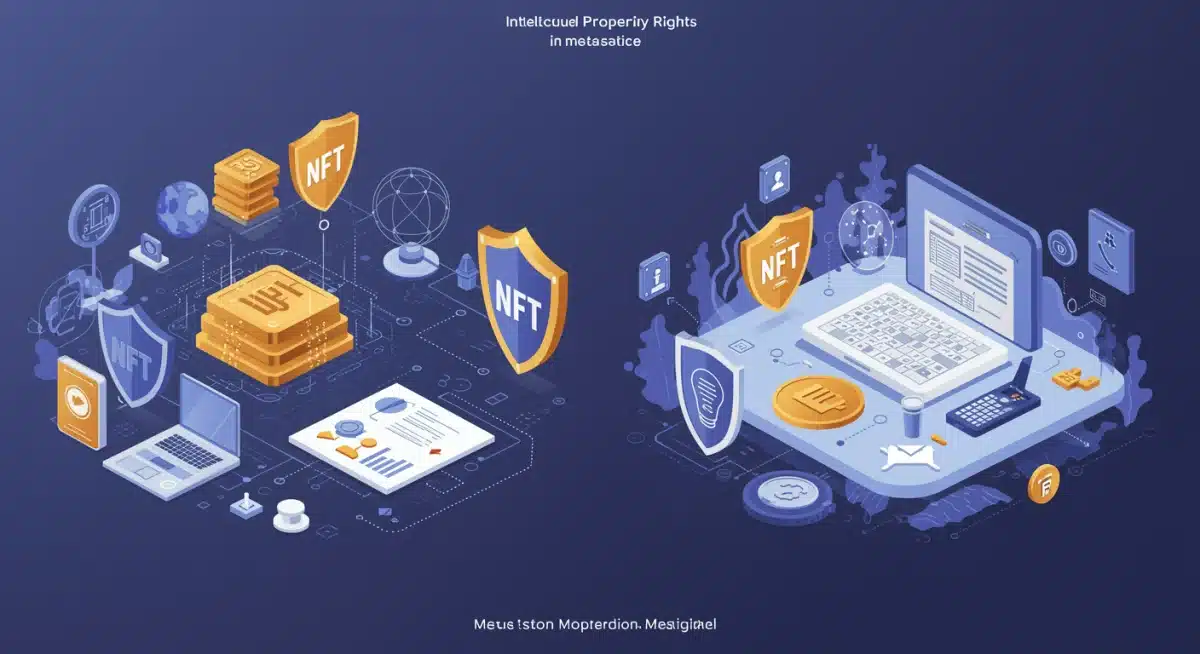
The concept of ownership in the metaverse introduces complex challenges for existing intellectual property (IP) laws. Digital assets, NFTs, and user-generated content demand clear frameworks for creation, transfer, and enforcement of rights.
U.S. developers must carefully consider how copyright, trademark, and patent laws apply to virtual goods, experiences, and even algorithms within these new digital realms. The lack of clear precedents often leaves creators and platforms in a legal gray area.
Establishing robust IP protection mechanisms and dispute resolution processes will be vital for fostering innovation and preventing widespread infringement. This includes educating users on their rights and responsibilities.
Copyright and NFTs in Virtual Worlds
Non-fungible tokens (NFTs) have brought the issue of digital ownership to the forefront, yet their legal status regarding underlying copyright remains contentious. Owning an NFT does not automatically confer copyright to the associated artwork or content.
Developers creating platforms for NFTs or integrating them into metaverse experiences must clearly define what rights are transferred upon purchase.
This involves meticulous drafting of terms of service and smart contracts to avoid future disputes over usage, reproduction, or commercialization.
- Clearly define NFT ownership rights in terms of service.
- Educate users about the scope of their digital asset rights.
- Implement robust systems for tracking digital asset provenance.
Trademark Infringement and Brand Presence
As brands establish a presence in the metaverse, the potential for trademark infringement escalates. Unauthorized use of logos, brand names, or even virtual storefronts can dilute brand value and mislead consumers.
U.S. developers building metaverse platforms must implement proactive measures to detect and address trademark violations. This includes establishing clear reporting mechanisms and collaborating with brand owners to protect their intellectual property in virtual spaces.
- Develop automated systems for detecting trademark misuse.
- Provide clear channels for brand owners to report infringements.
- Educate users on respecting brand IP within the metaverse.
Digital Identity and Authenticity: Verifying Virtual Selves
Establishing and verifying digital identities in the metaverse presents both technical and ethical dilemmas. The ability to create anonymous or pseudonymous identities offers creative freedom but also opens doors to misuse, harassment, and fraud.
U.S. developers face the challenge of balancing user privacy with the need for accountability and safety within virtual environments. This requires innovative solutions for identity verification that do not compromise personal data or user autonomy.
By January 2026, robust frameworks for digital identity will be critical for fostering trust and ensuring responsible behavior. This includes considering decentralized identity solutions that empower users with control over their personal information.
Anonymity vs. Accountability
The tension between user anonymity and the need for accountability is a central ethical concern in the metaverse. While anonymity can protect users from doxing or harassment, it can also embolden bad actors to engage in harmful behaviors without consequence.
Developers must explore mechanisms that allow for a spectrum of identity verification, from fully anonymous to fully authenticated, depending on the context and risk level of interactions. This could involve reputation systems or graded identity proofs.
To build a safer social fabric, developers should offer tiered identity verification options tailored to specific activities while implementing reputation systems that actively foster positive community behavior.
Complementing these preventive measures, providing clear and accessible reporting tools for harassment or misconduct ensures that users can quickly flag issues, keeping the virtual environment accountable and secure.

The Challenge of Deepfakes and Impersonation
The sophisticated graphics and AI capabilities of the metaverse make it ripe for deepfakes and impersonation attempts. Users could be tricked by convincing replicas of real individuals or entities, leading to scams, misinformation, or emotional distress.
U.S. developers need to integrate advanced detection technologies and user education to combat these threats. Transparency about AI-generated content and clear indicators of verified identities will be crucial for maintaining trust and preventing manipulation.
- Integrate AI-powered deepfake detection tools.
- Clearly label AI-generated content or avatars.
- Educate users on how to identify and report impersonation.
Jurisdictional Challenges: The Borderless Digital Frontier
The inherently borderless nature of the metaverse poses significant jurisdictional challenges for U.S. developers. Laws and regulations vary widely across different countries and regions, creating a complex web of compliance requirements.
Determining which laws apply to a virtual transaction, interaction, or incident when users are located in different physical jurisdictions is a pressing concern. This ambiguity can lead to enforcement difficulties and legal uncertainty for platforms and users alike.
By January 2026, clarity on these jurisdictional issues will be essential for global metaverse development. International cooperation and the establishment of common legal principles may become necessary to avoid a fragmented digital landscape.
Applying Real-World Laws to Virtual Spaces
The application of real-world laws, such as consumer protection, gambling, or securities regulations, to virtual economies and activities is far from straightforward. What constitutes a regulated activity in a physical jurisdiction may not have a clear equivalent in the metaverse.
U.S. developers must conduct thorough legal analyses to identify potential regulatory overlaps and compliance obligations based on their target audience and the nature of their metaverse offerings.
This often requires consulting with legal experts specializing in international law.
To navigate the complexities of digital boundaries, developers must carefully map real-world legal categories to virtual activities while seeking specialized legal counsel to manage cross-border compliance.
Given the fluidity of the space, it is equally vital to monitor international regulatory developments closely to ensure that global operations remain aligned with emerging standards.
Enforcement and Dispute Resolution
Even when a relevant law can be identified, enforcing it across multiple jurisdictions within the metaverse presents practical difficulties. Traditional legal mechanisms may struggle to keep pace with the speed and global reach of virtual interactions.
Developers should consider implementing robust internal dispute resolution mechanisms, arbitration clauses, and clear reporting channels for illegal activities. Collaboration with law enforcement agencies across borders will also be critical for addressing serious offenses.
- Establish clear in-platform dispute resolution processes.
- Include arbitration clauses in user agreements.
- Build relationships with international law enforcement.
Content Moderation and Harmful Content: Shaping Safe Environments
Ensuring a safe and inclusive environment within the metaverse hinges on effective content moderation strategies. The immersive and interactive nature of these platforms can amplify the impact of harmful content, including hate speech, harassment, and explicit material.
U.S. developers face the ethical imperative to protect users from such content while upholding principles of free expression. Striking this balance requires sophisticated AI-driven tools, transparent policies, and responsive human moderation teams.
By January 2026, proactive approaches to content moderation will be non-negotiable for building trustworthy and widely adopted metaverse experiences. This includes addressing the unique challenges posed by 3D environments and real-time interactions.
Defining and Detecting Harmful Content
Defining what constitutes harmful content in the metaverse is a complex task, as cultural norms and legal standards vary globally. Developers must establish clear, publicly accessible community guidelines that outline prohibited behaviors and content types.
Advanced AI and machine learning models are becoming indispensable for detecting harmful content in real-time, including nuanced forms of harassment or hate speech that might be expressed through gestures, voice, or custom avatars. However, human oversight remains vital for context and accuracy.
- Develop comprehensive and accessible community guidelines.
- Utilize AI for real-time content moderation.
- Train human moderators on metaverse-specific contexts.
Balancing Free Expression with User Safety
The tension between allowing free expression and protecting users from harm is a perennial challenge for online platforms, amplified in the metaverse. Overly restrictive policies can stifle creativity, while lax policies can create toxic environments.
U.S. developers should adopt a nuanced approach, prioritizing safety in sensitive areas while allowing for diverse forms of expression elsewhere. This might involve age-gating content, offering customizable safety settings, and providing robust blocking and reporting tools.
- Implement age-appropriate content restrictions.
- Offer users customizable safety and privacy settings.
- Provide easy-to-use blocking and reporting features.
| Key Consideration | Brief Description |
|---|---|
| Data Privacy & Security | Protecting user data, including biometrics, under evolving regulations. |
| Intellectual Property | Defining ownership and combating infringement of digital assets. |
| Digital Identity | Balancing anonymity with accountability and preventing impersonation. |
| Jurisdictional Challenges | Applying real-world laws to borderless virtual environments. |
Frequently Asked Questions About Metaverse Legal and Ethical Considerations
The primary data privacy concerns in the metaverse revolve around the extensive collection of personal and biometric data. Developers must ensure transparent consent, robust security for sensitive information, and compliance with regulations like CCPA to build user trust and avoid legal penalties by January 2026.
Intellectual property rights in the metaverse are complex, particularly concerning NFTs. Owning an NFT typically doesn’t transfer underlying copyright. Developers need clear terms of service defining transferred rights and robust systems to prevent trademark infringement and protect digital creations effectively by January 2026.
Digital identity verification in the metaverse balances user anonymity with accountability. Challenges include preventing impersonation, combating deepfakes, and ensuring user safety without compromising privacy. Developers need innovative solutions for identity management to foster trust and responsible behavior by January 2026.
The borderless nature of the metaverse creates significant jurisdictional challenges, making it difficult to determine which laws apply to global interactions. U.S. developers must navigate varying international regulations, apply real-world laws to virtual spaces, and establish effective cross-border dispute resolution by January 2026.
Content moderation is crucial for maintaining a safe and inclusive metaverse by January 2026. Developers must define and detect harmful content, balancing free expression with user safety. This involves implementing AI-driven tools, clear community guidelines, and responsive human teams to address hate speech and harassment effectively.
Looking Ahead
The journey of navigating the Metaverse is just beginning, demanding continuous adaptation and foresight.
The outlined challenges (data privacy, intellectual property, digital identity, jurisdiction, and content moderation) are not static; they evolve with technological advancements and user behavior.
U.S. developers must remain vigilant, collaborating with policymakers, legal experts, and the global community to forge a metaverse that is both innovative and responsible. The coming months will be critical in shaping the regulatory frameworks that will govern these immersive digital worlds.
Proactive engagement and a commitment to ethical design principles will ultimately determine the success and longevity of metaverse platforms. The capacity for navigating the Metaverse will define the future of digital interaction.