AI Security Vulnerabilities 2026: Protecting Data with Automation

The latest developments in AI Security reveal new vulnerabilities as artificial intelligence systems become more widespread. This update provides key insights into the evolving threat landscape.
As AI continues to integrate into critical systems, addressing AI Security vulnerabilities in 2026 becomes crucial. Understanding how these risks can impact data protection is essential for all industries.
This report highlights proactive measures being taken, especially the role of advanced automation in safeguarding sensitive data. Staying informed about AI Security is key to mitigating potential threats.
The Evolving Threat Landscape in 2026
The year 2026 marks a critical juncture in AI adoption, with systems processing vast amounts of sensitive information across diverse sectors. This extensive reliance creates a fertile ground for new and more sophisticated cyber threats, making the discussion around AI security vulnerabilities 2026 more urgent than ever.
Malicious actors are increasingly leveraging AI to enhance their attack capabilities, from crafting highly convincing phishing campaigns to orchestrating autonomous intrusions. The traditional perimeter defense mechanisms are proving insufficient against these adaptive threats, demanding a paradigm shift in cybersecurity strategies.
Experts from the National Institute of Standards and Technology (NIST) and the Cybersecurity and Infrastructure Security Agency (CISA) have highlighted several key areas of concern.
These include data poisoning, model evasion, and the exploitation of vulnerabilities within AI development pipelines, all contributing to the complexity of protecting digital assets.
Emerging Attack Vectors and AI’s Role
New attack vectors are emerging that specifically target the unique characteristics of AI systems. Adversarial machine learning, where attackers subtly manipulate input data to cause misclassifications or erroneous outputs, is becoming a significant concern for data integrity and system reliability.
Furthermore, the increased use of AI in decision-making processes means that compromised AI models can have far-reaching consequences, extending beyond data breaches to critical operational failures.
The implications for national security and economic stability are substantial, underscoring the importance of robust defenses against AI security vulnerabilities 2026.
- Data poisoning attacks manipulate training data to corrupt AI models.
- Model evasion techniques trick AI models into making incorrect predictions.
- Supply chain attacks target vulnerabilities in AI development components.
Understanding AI-Specific Vulnerabilities
Unlike conventional software, AI systems exhibit unique vulnerabilities stemming from their learning processes and reliance on vast datasets. These intrinsic characteristics introduce new challenges for security teams, who must now contend with threats that are often difficult to detect using traditional methods.
One major area of concern is the interpretability of AI models. The ‘black box’ nature of many advanced AI algorithms makes it challenging to understand why a model made a particular decision, complicating forensic analysis after a security incident and hindering efforts to identify and patch AI security vulnerabilities 2026.
Another critical aspect is the integrity of training data. AI models are only as good as the data they learn from, and if this data is compromised or biased, the entire system can be exploited or produce unreliable outcomes. Ensuring data provenance and immutability is therefore a cornerstone of AI security.
Deepfakes and Generative AI Exploitation
The proliferation of generative AI, while offering creative possibilities, also presents significant security risks. Deepfakes, for instance, can be used to create highly realistic but entirely fabricated audio, video, or images, leading to misinformation campaigns, identity theft, and corporate espionage.
These AI-generated deceptions are becoming increasingly sophisticated, making it difficult for humans and even other AI systems to distinguish real from fake.
This raises serious questions about trust in digital information and the need for advanced authentication and verification mechanisms to counter these AI security vulnerabilities 2026.
- Deepfakes are used for disinformation and identity fraud.
- Generative adversarial networks (GANs) can create convincing fake content.
- Verification tools are essential to combat AI-generated deception.
The Role of Advanced Automation in Defense
As the scale and complexity of AI threats grow, human security analysts alone cannot keep pace. Advanced automation, powered by AI itself, is emerging as an indispensable tool in the fight against AI security vulnerabilities 2026.
These automated systems can monitor, detect, and respond to threats at machine speed, significantly reducing response times.
Automated threat detection systems leverage machine learning to identify anomalous behavior and potential attacks in real-time, often before they can cause significant damage.
By analyzing vast quantities of network traffic and system logs, these systems can spot patterns indicative of sophisticated AI-driven intrusions that might otherwise go unnoticed.
Furthermore, security orchestration, automation, and response (SOAR) platforms are becoming central to modern cybersecurity operations. These platforms automate routine security tasks, freeing up human experts to focus on more complex strategic challenges and enhancing overall resilience against emerging threats.
Automated Threat Intelligence and Proactive Defense
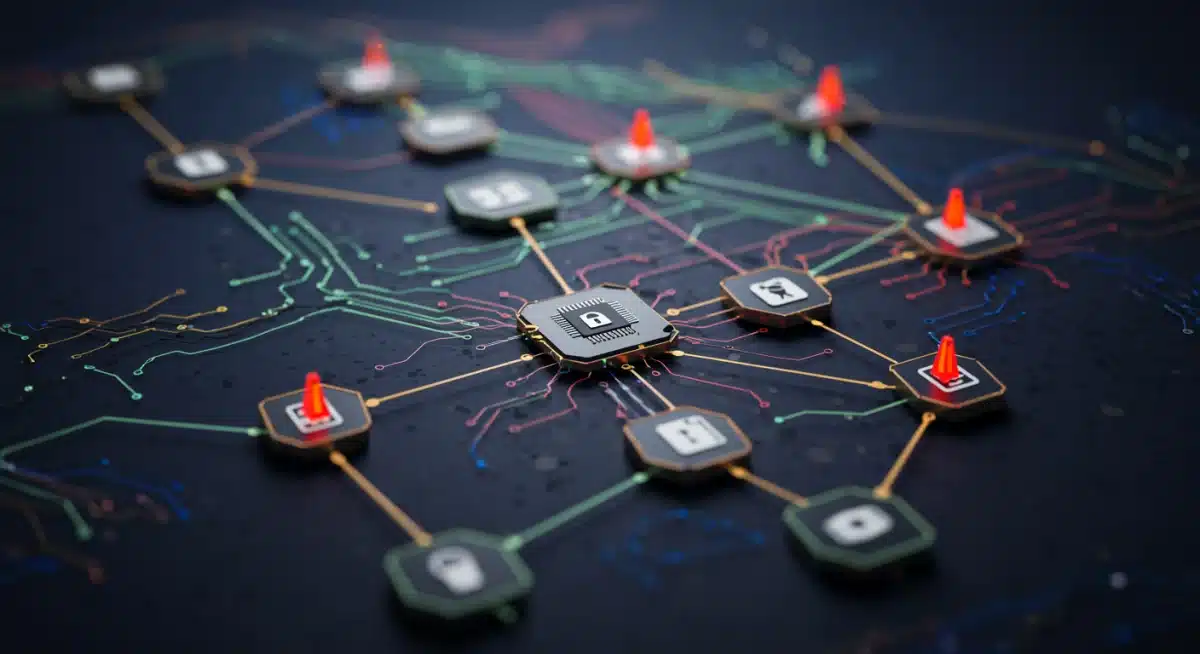
Advanced automation also plays a crucial role in proactive defense through automated threat intelligence. AI-driven systems can continuously scan the dark web, open-source intelligence feeds, and global threat databases to identify new attack techniques, malware variants, and emerging AI security vulnerabilities 2026.
This intelligence is then automatically integrated into security policies and defense mechanisms, allowing organizations to adapt their defenses before specific attacks materialize.
Such proactive measures are vital in an environment where threat actors are constantly innovating and exploiting new weaknesses.
- AI automates threat detection and incident response.
- SOAR platforms streamline security operations.
- Automated intelligence provides proactive defense capabilities.
Protecting Data Integrity and Privacy
Data is the lifeblood of AI, and its integrity and privacy are paramount. Compromised data can not only lead to direct financial losses but also erode public trust and undermine the reliability of AI systems. Therefore, robust data protection strategies are integral to addressing AI security vulnerabilities 2026.
Encrypting data at rest and in transit is a foundational security measure, but AI systems require more nuanced approaches. Homomorphic encryption, for example, allows computations to be performed on encrypted data without decrypting it, offering a revolutionary way to maintain data privacy while still leveraging AI for analysis.
Additionally, privacy-preserving machine learning techniques, such as federated learning and differential privacy, enable AI models to be trained on decentralized datasets without exposing individual user data. These methods are critical for compliance with stringent data protection regulations like GDPR and CCPA.
Securing AI Development Pipelines
The security of the entire AI development lifecycle, from data collection and model training to deployment and maintenance, is crucial.
Vulnerabilities introduced at any stage can propagate throughout the system, creating exploitable weaknesses that contribute to AI security vulnerabilities 2026.
Implementing secure coding practices, conducting regular security audits of AI models, and utilizing secure development environments are essential steps.
Furthermore, continuous monitoring of AI models in production for drift or adversarial attacks can help detect and mitigate emerging threats before they impact operations.
- Homomorphic encryption protects data during AI computation.
- Federated learning enhances data privacy during model training.
- Secure development practices are critical for AI pipeline integrity.
Regulatory Frameworks and Compliance Challenges
The rapid advancement of AI has outpaced the development of comprehensive regulatory frameworks, creating a complex landscape for organizations to navigate.
Governments worldwide are grappling with how to effectively regulate AI to foster innovation while mitigating risks, including AI security vulnerabilities 2026.
In the United States, discussions around federal AI legislation are ongoing, with a focus on accountability, transparency, and fairness in AI systems.
Meanwhile, sector-specific regulations are emerging, particularly in industries such as finance, healthcare, and defense, which rely heavily on AI and handle sensitive data.
Compliance with these evolving regulations presents significant challenges for organizations, requiring substantial investment in security infrastructure, expertise, and continuous monitoring. Failure to comply can result in severe penalties, reputational damage, and loss of consumer trust.
Global Harmonization and Standards
The global nature of AI development and deployment necessitates international cooperation and harmonization of standards.
Efforts by organizations like the International Organization for Standardization (ISO) and the European Union Agency for Cybersecurity (ENISA) aim to establish common guidelines for AI security and ethics.
Achieving a consistent approach to managing AI security vulnerabilities 2026 across different jurisdictions is vital for fostering a secure and trustworthy AI ecosystem.
Such harmonization would simplify compliance for multinational corporations and facilitate cross-border collaboration in addressing shared security threats.
- AI regulations are evolving globally, impacting compliance.
- Sector-specific laws are emerging for critical AI applications.
- International standards aim to harmonize AI security practices.
Best Practices for AI Security in 2026
To effectively combat AI security vulnerabilities 2026, organizations must adopt a multi-layered security approach that integrates technological solutions with robust policies and human expertise. Proactive measures are far more effective than reactive responses in the face of sophisticated AI-driven threats.
Regular security audits and penetration testing of AI systems are crucial for identifying weaknesses before attackers can exploit them.
These assessments should go beyond traditional software testing to include adversarial robustness testing, specifically designed to challenge AI models against malicious inputs.
Furthermore, fostering a culture of security awareness among employees, particularly those involved in AI development and deployment, is essential. Human error remains a significant vulnerability, and continuous training can help mitigate risks associated with social engineering and insider threats.
Implementing a Zero-Trust Architecture
A zero-trust security model, where no user or device is inherently trusted, is increasingly recommended for AI environments.
This approach mandates strict verification for every access request, regardless of whether it originates inside or outside the network perimeter, thereby minimizing the attack surface for AI security vulnerabilities 2026.
Micro-segmentation, multi-factor authentication, and continuous monitoring of user behavior are key components of a zero-trust strategy. By segmenting networks and applying granular access controls, organizations can limit the lateral movement of attackers even if an initial breach occurs.
- Regular security audits and adversarial testing are vital.
- Employee security awareness training reduces human error.
- Zero-trust architecture enhances AI system security.

Future Outlook: AI Securing AI
The ultimate frontier in addressing AI security vulnerabilities 2026 lies in the development of AI systems capable of autonomously defending other AI systems. This concept, often referred to as ‘AI securing AI,’ promises a future where cyber defenses are as intelligent and adaptive as the threats they face.
Research is actively underway in areas such as explainable AI (XAI) to improve the transparency and interpretability of AI models, making it easier to identify and debug security flaws. Self-healing AI systems that can automatically detect and repair vulnerabilities are also on the horizon, offering unprecedented levels of resilience.
While the full realization of AI securing AI is still some years away, incremental advancements are already being integrated into modern security products.
These include AI-powered vulnerability scanners, autonomous penetration testing tools, and self-adapting intrusion detection systems, all contributing to a more robust defense posture against AI security vulnerabilities 2026.
Ethical Considerations and Responsible AI Development
As AI takes on greater responsibility for security, ethical considerations become paramount. Ensuring that AI security systems operate without bias, respect privacy, and are transparent in their operations is crucial for maintaining public trust and avoiding unintended consequences.
Responsible AI development, incorporating security-by-design principles from the outset, is essential. This includes rigorous testing for fairness, accountability, and transparency, alongside traditional security evaluations.
The future of AI security depends not only on technological prowess but also on a commitment to ethical deployment.
- AI securing AI promises autonomous defense capabilities.
- Explainable AI (XAI) enhances model transparency.
- Ethical considerations are crucial for responsible AI security.
| Key Point | Brief Description |
|---|---|
| Emerging Threats | AI is exploited for sophisticated attacks like data poisoning and deepfakes. |
| Automation’s Role | Advanced automation is vital for real-time threat detection and response. |
| Data Protection | Homomorphic encryption and federated learning secure AI data. |
| Zero-Trust Models | Implementing zero-trust architecture is crucial for AI environments. |
Frequently Asked Questions About AI Security in 2026
The main vulnerabilities include adversarial attacks like data poisoning and model evasion, exploitation of AI development pipelines, and the misuse of generative AI for deepfakes. These threats target the unique characteristics of AI systems, making traditional security measures less effective.
Advanced automation, powered by AI, enables real-time threat detection, rapid incident response, and proactive threat intelligence. Automated systems can monitor vast datasets and network traffic at machine speed, identifying anomalies and responding to threats faster than human analysts alone.
Data integrity is paramount because AI models are highly dependent on the quality and trustworthiness of their training data. Compromised data can lead to biased models, incorrect decisions, and exploitable weaknesses, highlighting the need for secure data pipelines and privacy-preserving techniques.
While a comprehensive global framework is still developing, several countries and regions are enacting sector-specific regulations for AI, particularly in sensitive areas like finance and healthcare. These regulations emphasize accountability, transparency, and robust security measures for AI systems.
Organizations should implement a multi-layered approach including regular security audits, adversarial robustness testing, employee security awareness training, and a zero-trust architecture. Secure-by-design principles throughout the AI development lifecycle are also critical for mitigating risks.
What Happens Now
The landscape of AI security vulnerabilities 2026 demands continuous vigilance and adaptation from organizations and governments.
The increasing sophistication of AI-driven threats necessitates a proactive and integrated approach to cybersecurity, where advanced automation is not just an advantage but a necessity.
Companies must invest in robust AI security frameworks, stay abreast of evolving regulations, and foster a culture of security awareness to protect their data and maintain trust in an increasingly AI-centric world.
The future of data protection hinges on our ability to outpace malicious actors leveraging AI through intelligent and automated defenses.