Navigating 2026 US AI Regulation: 3-Month Compliance Plan
Latest developments on Navigating the 2026 AI Regulatory Landscape in the US: A 3-Month Action Plan for Compliance, with key facts, verified sources and what readers need to monitor next in Estados Unidos, presented clearly in Inglês (Estados Unidos) (en-US).
Navigating the 2026 AI Regulatory Landscape in the US: A 3-Month Action Plan for Compliance is shaping today’s agenda with new details released by officials and industry sources. This update prioritizes what changed, why it matters and what to watch next, in a straightforward news format.
Understanding the Evolving US AI Regulatory Landscape
The regulatory environment for Artificial Intelligence in the United States is rapidly evolving, with significant developments anticipated to crystallize by 2026. Businesses and organizations must begin proactive planning now to meet forthcoming compliance obligations and mitigate potential risks.
This includes closely monitoring legislative proposals, executive orders, and agency guidelines that are currently being shaped across various federal and state levels. The goal is to establish a robust framework that balances innovation with ethical considerations and consumer protection.
Early engagement and strategic foresight are paramount for successful Navigating the 2026 AI Regulatory Landscape in the US: A 3-Month Action Plan for Compliance. Companies that delay their preparation risk facing substantial penalties, reputational damage, and operational disruptions.
Key Legislative and Executive Initiatives
Several legislative bills and executive actions are currently underway, signaling the direction of future AI governance. These initiatives often focus on data privacy, algorithmic transparency, bias mitigation, and accountability in AI systems.
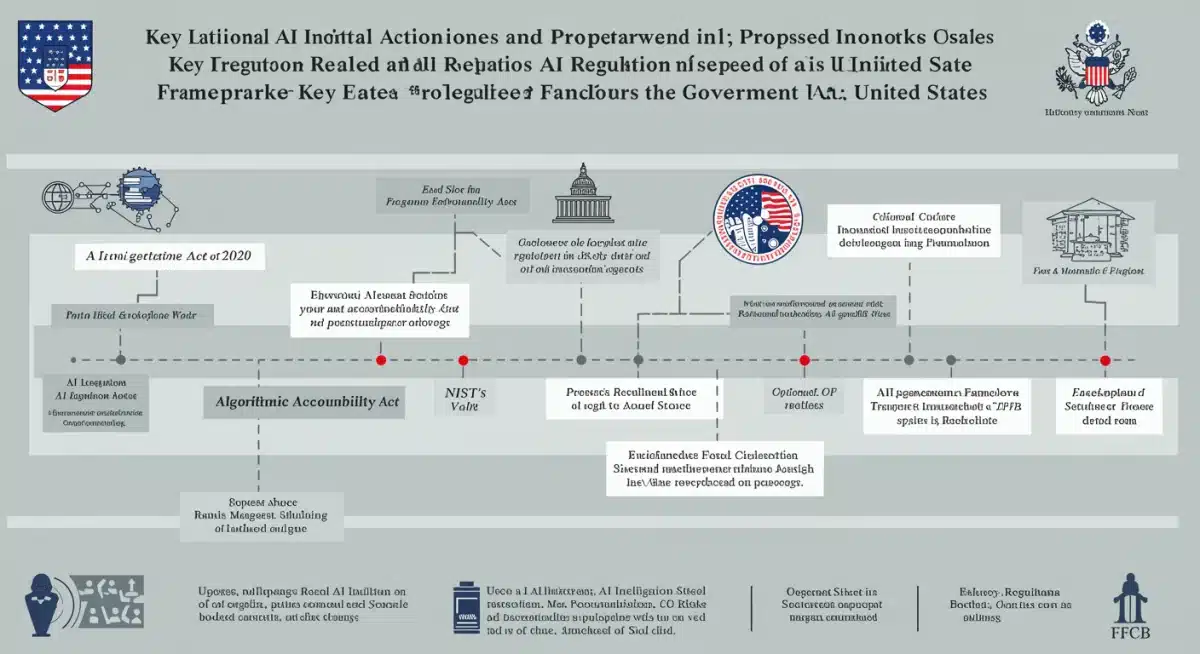
For instance, the National Institute of Standards and Technology (NIST) AI Risk Management Framework provides a voluntary foundation that is likely to inform mandatory regulations. Other proposals address specific sectors, such as healthcare and finance, where AI deployment carries unique risks.
Keeping abreast of these diverse efforts is critical for Navigating the 2026 AI Regulatory Landscape in the US: A 3-Month Action Plan for Compliance. The fragmented nature of US regulation means that a comprehensive understanding of both federal and state-level mandates will be essential.
Federal Efforts Shaping AI Governance
The Biden administration’s Executive Order on the Safe, Secure, and Trustworthy Development and Use of Artificial Intelligence, issued in October 2023, has set a clear precedent. This order directs various federal agencies to develop standards, guidelines, and best practices for AI use across critical sectors.
Agencies like the Commerce Department, the Department of Homeland Security, and the Department of Justice are actively working to implement these directives. Their forthcoming reports and recommendations will form the bedrock of the 2026 regulatory framework.
- NIST AI Risk Management Framework adoption.
- Interagency collaboration on AI safety and security.
- Development of sector-specific AI guidelines.
State-Level Regulations and Their Impact
Beyond federal mandates, several states are also enacting their own AI-related legislation, particularly concerning data privacy and automated decision-making. California’s Consumer Privacy Act (CCPA) and subsequent amendments, for example, have implications for AI systems handling personal data.
Other states are exploring laws to address algorithmic bias in hiring and lending, adding another layer of complexity for businesses operating nationwide. These state-specific requirements necessitate a flexible and adaptable compliance strategy.
Understanding the interplay between federal and state regulations is a crucial component of Navigating the 2026 AI Regulatory Landscape in the US: A 3-Month Action Plan for Compliance. A patchwork of laws means that a one-size-fits-all approach will likely be insufficient.
Month 1: Initial Assessment and Policy Review
The first month of the 3-month action plan should focus on a thorough internal assessment and a comprehensive review of current and proposed AI policies. This foundational step is crucial for identifying potential compliance gaps and understanding the scope of future requirements.
Organizations must conduct an inventory of all AI systems currently in use or under development, documenting their purpose, data sources, and decision-making processes. This inventory will serve as the baseline for evaluating regulatory exposure.
Engaging legal and compliance teams to analyze the existing regulatory landscape, including privacy laws and sector-specific rules, is essential for Navigating the 2026 AI Regulatory Landscape in the US: A 3-Month Action Plan for Compliance effectively. This initial phase sets the stage for strategic planning.
Inventorying AI Systems and Data Usage
A critical first step involves meticulously cataloging every AI application within the organization, from customer service chatbots to sophisticated predictive analytics tools. For each system, identify the type of AI, its function, and the data it processes.
Documenting data provenance, usage, and storage practices is equally important, especially concerning sensitive personal information. This detailed inventory helps pinpoint areas that might fall under strict data governance regulations.
- Identify all AI systems in operation.
- Document data sources and processing methods.
- Assess data privacy implications for each AI use case.
Reviewing Current and Emerging AI Regulations
Legal and compliance departments should undertake a comprehensive review of all relevant federal and state AI regulations, including proposed legislation. This involves understanding the specific requirements for transparency, fairness, and accountability.
Pay close attention to any industry-specific guidelines or recommendations issued by regulatory bodies. The financial, healthcare, and critical infrastructure sectors often face heightened scrutiny and more stringent compliance demands.
This continuous monitoring of legal developments is fundamental for Navigating the 2026 AI Regulatory Landscape in the US: A 3-Month Action Plan for Compliance. The regulatory picture is dynamic, and staying updated is not a one-time task.
Month 2: Gap Analysis and Strategy Development
The second month is dedicated to a detailed gap analysis, comparing current AI practices against anticipated 2026 regulatory requirements. This phase involves identifying discrepancies and formulating a strategic roadmap to bridge those gaps.
Organizations should prioritize risks based on their potential impact and likelihood, focusing on areas such as algorithmic bias, data security vulnerabilities, and transparency deficits. Developing a clear understanding of these risks is crucial for effective mitigation.
Establishing an internal AI governance framework, including clear roles and responsibilities, is a key outcome of this month. This framework will guide the organization in Navigating the 2026 AI Regulatory Landscape in the US: A 3-Month Action Plan for Compliance.
Identifying Compliance Gaps and Risk Areas
Using the AI system inventory and regulatory review from Month 1, conduct a rigorous gap analysis. This involves mapping each AI system’s characteristics against known and anticipated regulatory requirements for 2026.
Specific attention should be paid to areas where explicit regulatory guidance is emerging, such as the need for impact assessments for high-risk AI systems or mechanisms for human oversight. Documenting these gaps provides a clear mandate for action.
Risk prioritization should consider both the severity of potential harm (e.g., discrimination, data breaches) and the probability of regulatory enforcement. This allows for a focused approach to resource allocation when Navigating the 2026 AI Regulatory Landscape in the US: A 3-Month Action Plan for Compliance.
Developing an AI Governance Framework
Based on the identified gaps, design or refine the organization’s internal AI governance framework. This framework should define policies for AI development, deployment, and monitoring, ensuring alignment with ethical principles and regulatory expectations.
Assign clear ownership for AI compliance, designating specific individuals or teams responsible for overseeing regulatory adherence and reporting. This ensures accountability and streamlines the compliance process.
- Define internal AI policies and ethical guidelines.
- Assign clear roles and responsibilities for AI governance.
- Establish a process for regular AI system audits and reviews.
Month 3: Implementation and Training
The final month of the initial 3-month action plan focuses on implementing the strategic changes identified in Month 2 and conducting comprehensive training. This phase is about operationalizing the compliance framework and embedding it into daily practices.
This includes updating internal policies, developing new technical controls, and implementing robust data governance procedures. Practical changes must be made to ensure AI systems are designed and used in a compliant manner.
Employee training across all relevant departments is critical to foster a culture of AI responsibility and compliance. Effective implementation is the culmination of Navigating the 2026 AI Regulatory Landscape in the US: A 3-Month Action Plan for Compliance.

Implementing Technical and Procedural Controls
This involves putting in place the necessary technical safeguards and procedural adjustments to meet regulatory standards. For example, implement tools for continuous monitoring of AI system performance to detect and address bias or drift.
Review and update data collection, storage, and processing protocols to align with privacy regulations. Ensure that mechanisms for user consent and data access requests are robust and transparent.
Establishing clear documentation standards for AI model development and decision-making processes will be crucial for demonstrating compliance to regulators. This proactive approach supports Navigating the 2026 AI Regulatory Landscape in the US: A 3-Month Action Plan for Compliance.
Conducting Comprehensive Employee Training
Training programs should be rolled out to all employees who interact with AI systems or whose work is impacted by them. This includes developers, data scientists, legal teams, and management.
Training should cover the organization’s AI governance policies, ethical guidelines, and specific regulatory requirements, emphasizing the importance of responsible AI use. Practical scenarios and case studies can enhance understanding and retention.
Regular refreshers and updates to training materials will ensure that employees remain informed about evolving regulatory expectations and best practices when Navigating the 2026 AI Regulatory Landscape in the US: A 3-Month Action Plan for Compliance.
Ongoing Monitoring and Adaptation
While the 3-month plan provides a strong starting point, compliance with AI regulations is an ongoing process, not a one-time event. The regulatory landscape will continue to evolve, requiring continuous monitoring and adaptation.
Organizations must establish mechanisms for regularly reviewing their AI systems and governance frameworks against new legislation or updated guidance. This proactive stance ensures sustained compliance and minimizes future risks.
Developing a flexible and responsive compliance strategy is key to long-term success in Navigating the 2026 AI Regulatory Landscape in the US: A 3-Month Action Plan for Compliance. The ability to quickly adapt to changes will be a competitive advantage.
| Key Milestone | Action Focus |
|---|---|
| Month 1: Assessment | Inventory AI systems, review federal and state policies. |
| Month 2: Strategy | Conduct gap analysis, develop AI governance framework. |
| Month 3: Implementation | Implement controls, conduct comprehensive employee training. |
| Ongoing: Adaptation | Continuous monitoring, policy updates, and risk mitigation. |
Frequently Asked Questions About US AI Regulation
The primary goal is to foster responsible AI innovation while ensuring safety, security, and trustworthiness. This includes addressing concerns about data privacy, algorithmic bias, and accountability, aiming for a balanced approach to technological advancement and societal well-being in the US AI regulatory landscape.
Federal regulations will likely set a baseline, while state laws may introduce more specific or stringent requirements, particularly in areas like data privacy. Organizations must navigate this complex interplay, ensuring compliance with both federal mandates and diverse state-level provisions for US AI Regulation 2026.
Businesses should immediately begin inventorying their AI systems, reviewing current legislative proposals, and conducting an internal gap analysis. This initial assessment is crucial for understanding potential compliance obligations and developing a proactive strategy for Navigating the 2026 AI Regulatory Landscape in the US: A 3-Month Action Plan for Compliance.
NIST’s AI Risk Management Framework provides voluntary guidance that is expected to heavily influence future mandatory regulations. It offers a structured approach to managing AI risks, covering governance, mapping, measuring, and managing, making it a key resource for US AI Regulation 2026 preparation.
Ongoing compliance requires continuous monitoring of regulatory developments, regular audits of AI systems, and adaptive internal governance frameworks. Establishing a culture of responsible AI use through consistent training and policy updates is also vital for sustained adherence to US AI Regulation 2026.
Next Steps
The evolving US AI regulatory landscape demands continuous vigilance and strategic adaptation. Organizations that prioritize a proactive approach to Navigating the 2026 AI Regulatory Landscape in the US: A 3-Month Action Plan for Compliance will be better positioned to innovate responsibly and avoid significant legal and reputational pitfalls. Monitoring legislative updates, investing in robust AI governance, and fostering a culture of ethical AI use are not just compliance requirements but strategic imperatives for future success.