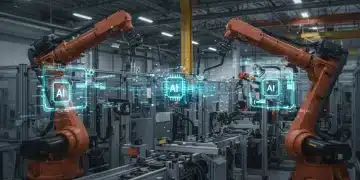
Predictive Maintenance with AI: Preventing Downtime & Saving Millions

The dawn of 2026 has transformed AI Predictive Maintenance from a luxury into a survival tool for modern industry. As global manufacturing faces tightening margins, these intelligent systems are now the primary line of defense against operational failure.
By leveraging advanced machine learning and real-time sensor diagnostics, facilities are successfully eliminating up to 50% of unplanned outages. These smart diagnostic tools analyze equipment health at a granular level, turning raw data into millions of dollars in annual savings.
This shift toward autonomous asset management is no longer a pilot project; it is a nationwide movement to secure American production. To remain competitive, leaders must now monitor how integrated digital twins and edge analytics are redefining factory reliability.
The Rise of AI Predictive Maintenance in 2026
The year 2026 marks a pivotal moment for AI Predictive Maintenance, as its adoption moves from early experimentation to widespread implementation.
Manufacturers are increasingly recognizing the tangible benefits of leveraging artificial intelligence to anticipate equipment failures, thereby optimizing operational efficiency and reducing unforeseen expenditures.
This shift is driven by advancements in AI algorithms, sensor technology, and data processing capabilities.
Industry leaders and analysts confirm that the integration of AI-driven solutions is no longer a luxury but a necessity for competitive advantage.
Companies that embrace AI Predictive Maintenance are reporting substantial reductions in maintenance costs, alongside improvements in production uptime and overall equipment effectiveness. These successes are setting new benchmarks for operational excellence across various industries.
The proliferation of IoT devices and edge computing further empowers AI Predictive Maintenance systems, allowing for real-time data collection and analysis directly at the source.
This immediacy means that potential issues can be identified and addressed before they escalate into major disruptions, fundamentally altering traditional maintenance paradigms.
The strategic importance of AI Predictive Maintenance cannot be overstated in today’s fast-paced manufacturing landscape.
Core Technologies Powering AI Predictive Maintenance
The effectiveness of AI Predictive Maintenance hinges on a sophisticated interplay of several advanced technologies, each contributing to its ability to forecast and prevent equipment failures.
At its heart are machine learning algorithms, which analyze vast datasets from operational machinery to identify patterns indicative of impending issues. These algorithms continuously learn and refine their predictions, becoming more accurate over time.
Sensor technology forms the backbone of data collection for AI Predictive Maintenance, gathering crucial information such as vibration, temperature, pressure, and acoustic signatures.
These sensors, often integrated into the machinery itself or retrofitted, provide a constant stream of real-time operational data. The quality and breadth of this data directly influence the accuracy and reliability of the predictive models.
Big data analytics and cloud computing infrastructure are essential for processing and storing the immense volumes of data generated by these systems.
Cloud platforms offer the scalability and computational power required for complex AI model training and deployment, making advanced predictive capabilities accessible to a wider range of manufacturers.
The synergy of these technologies creates a robust framework for effective AI Predictive Maintenance.
Machine Learning Algorithms and Their Role
Machine learning, particularly techniques like supervised and unsupervised learning, plays a crucial role in interpreting sensor data.
These algorithms are trained on historical data, including past failures, maintenance records, and operational parameters, to recognize subtle anomalies that precede equipment malfunctions. This allows for the proactive scheduling of maintenance activities.
- Anomaly Detection: Identifying deviations from normal operating patterns that may indicate an impending failure.
- Failure Prediction: Forecasting the remaining useful life (RUL) of components to schedule maintenance optimally.
- Root Cause Analysis: Pinpointing the underlying reasons for identified problems, aiding in long-term solutions.
Deep learning models, a subset of machine learning, are also gaining traction in AI Predictive Maintenance for their ability to process more complex and unstructured data, such as images or raw audio.
Their capacity to uncover intricate relationships within data further enhances the precision of predictive models, reducing false positives and improving overall system reliability.
This continuous evolution of AI techniques is central to the ongoing success of AI Predictive Maintenance.
Sensor Technology and Data Acquisition
The deployment of advanced sensors is fundamental to collecting the rich, high-fidelity data that fuels AI Predictive Maintenance systems.
These sensors are strategically placed on critical machinery to monitor key performance indicators and environmental conditions.
The proliferation of wireless sensor networks has simplified deployment and reduced installation costs, making these systems more accessible.
- Vibration Sensors: Detect imbalances, misalignments, and bearing wear in rotating machinery.
- Temperature Sensors: Monitor heat generation, indicating friction or electrical issues.
- Acoustic Sensors: Identify unusual noises that could signify mechanical degradation.
The integration of these sensors with IoT platforms allows for seamless data transmission to centralized analytics engines. Edge computing devices are increasingly being used to process data locally before sending it to the cloud, reducing latency and bandwidth requirements.
This distributed processing capability is vital for real-time decision-making in demanding industrial environments, ensuring that AI Predictive Maintenance remains at the forefront of operational efficiency.
Preventing Downtime: A Direct Impact of AI Predictive Maintenance
The most immediate and significant benefit of AI Predictive Maintenance is its unparalleled ability to prevent unplanned downtime, a critical factor for manufacturers.
By accurately predicting when equipment is likely to fail, companies can schedule maintenance interventions proactively, avoiding sudden breakdowns that halt production lines and lead to substantial losses in revenue and productivity.
This strategic shift from reactive to proactive maintenance is transforming industrial operations.
Unplanned downtime can have cascading effects, including missed production targets, delayed shipments, and damage to customer relationships.
AI Predictive Maintenance mitigates these risks by providing timely warnings, allowing maintenance teams to address issues during scheduled downtimes or off-peak hours.
This approach not only keeps operations running smoothly but also extends the lifespan of valuable assets.
The precision offered by AI-driven predictions means that maintenance efforts are focused exactly where and when they are needed, eliminating unnecessary inspections and repairs.
This targeted approach minimizes the time equipment is out of service and optimizes resource allocation, ensuring that production capacity is maximized.
The financial implications of this prevention are enormous for manufacturers globally, reinforcing the value of AI Predictive Maintenance.
Saving Millions: The Economic Imperative of AI Predictive Maintenance
Beyond preventing downtime, AI Predictive Maintenance offers a compelling economic argument, directly contributing to millions in savings for manufacturers.
These savings stem from various avenues, including reduced maintenance costs, optimized spare parts inventory, and increased asset utilization. The investment in AI predictive solutions yields a significant return by streamlining operations and eliminating waste.
Traditional preventive maintenance often involves time-based interventions, leading to unnecessary replacement of parts or servicing of equipment that is still in good condition.
AI Predictive Maintenance, by contrast, enables condition-based maintenance, ensuring that repairs are only performed when truly necessary.
This precision reduces material costs, labor expenses, and the overall maintenance budget, creating substantial financial efficiencies.
Furthermore, the ability to accurately forecast equipment health allows companies to optimize their spare parts inventory.
Instead of holding excessive stock for every possible failure, manufacturers can maintain leaner inventories, ordering parts just-in-time for predicted maintenance events.
This minimizes carrying costs and reduces the risk of obsolescence, adding another layer of savings facilitated by AI Predictive Maintenance.
Case Studies and Industry Adoption in 2026
The year 2026 has seen a surge in compelling case studies demonstrating the tangible benefits of AI Predictive Maintenance across diverse manufacturing sectors.
From automotive to aerospace, and from chemicals to consumer goods, companies are reporting remarkable successes in reducing operational costs and enhancing efficiency. These real-world applications underscore the maturity and reliability of AI-driven solutions.
One prominent example comes from a leading automotive manufacturer that implemented an AI Predictive Maintenance system across its assembly lines.
The company reported a 25% reduction in unscheduled downtime within the first year, translating into millions of dollars in saved production losses.
This success was attributed to the system’s ability to accurately predict failures in robotic components and conveyor systems, allowing for proactive interventions.
Another compelling case involves a major chemical plant that deployed AI Predictive Maintenance to monitor its critical pumps and valves.
By leveraging sensor data and machine learning, the plant achieved a 15% decrease in maintenance expenditures and extended the operational life of its equipment by an average of 20%.
These examples highlight the versatility and profound economic impact of AI Predictive Maintenance in various industrial settings.

Challenges and Considerations for Implementation
While the benefits of AI Predictive Maintenance are clear, its successful implementation is not without challenges. Manufacturers must navigate complexities related to data quality, system integration, and the need for specialized skill sets.
Addressing these hurdles effectively is crucial for maximizing the return on investment from AI predictive solutions.
Data quality and availability represent a significant hurdle. AI models are only as good as the data they are trained on, meaning that incomplete, inaccurate, or inconsistent data can lead to flawed predictions.
Companies must invest in robust data collection infrastructures and data governance strategies to ensure the integrity of the information feeding their AI Predictive Maintenance systems.
Integrating new AI solutions with existing legacy systems can also be a complex undertaking, requiring careful planning and execution.
Interoperability issues and the need for seamless data flow between disparate platforms often demand significant IT resources.
Furthermore, the specialized knowledge required to develop, deploy, and manage AI Predictive Maintenance systems necessitates investment in training or hiring skilled personnel.
The Future Landscape of AI Predictive Maintenance
Looking ahead, the future of AI Predictive Maintenance is poised for even greater advancements and wider adoption, driven by emerging technologies and evolving industry demands.
Innovations in areas like explainable AI, digital twins, and autonomous maintenance are set to further enhance the capabilities and impact of predictive solutions. The trajectory suggests an increasingly intelligent and self-optimizing industrial environment.
Explainable AI (XAI) will play a crucial role in building trust and transparency in predictive models. As AI systems become more complex, understanding why a particular prediction is made becomes vital for human operators to act confidently on the insights provided.
XAI will help bridge the gap between complex algorithms and practical decision-making in AI Predictive Maintenance.
The concept of digital twins, virtual replicas of physical assets, is also set to revolutionize AI Predictive Maintenance.
By simulating the behavior of machinery in a digital environment, manufacturers can test various scenarios, predict potential failures with higher accuracy, and optimize maintenance strategies before implementing them in the real world.
This fusion of AI and digital twins promises unprecedented levels of operational foresight for AI Predictive Maintenance.
Strategic Implementation for Manufacturers
For manufacturers aiming to leverage AI Predictive Maintenance effectively, a strategic approach is paramount. This involves not only investing in the right technology but also fostering a culture of data-driven decision-making and continuous improvement.
Successful implementation requires a clear roadmap, starting with pilot projects and scaling up gradually.
Initial steps often involve identifying critical assets where downtime is most costly and where data collection is feasible.
Beginning with a focused pilot project allows organizations to gain experience, demonstrate value, and address challenges on a smaller scale before a broader rollout. This iterative approach minimizes risk and builds internal expertise in AI Predictive Maintenance.
Furthermore, fostering collaboration between IT, operations, and maintenance teams is essential.
The interdisciplinary nature of AI Predictive Maintenance requires a holistic approach, ensuring that technological solutions align with operational needs and that insights are effectively translated into actionable strategies.
This collaboration is key to unlocking the full potential of AI Predictive Maintenance.
| Key Point | Brief Description |
|---|---|
| Downtime Prevention | AI accurately predicts equipment failure, enabling proactive maintenance. |
| Cost Savings | Reduces maintenance expenses, optimizes spare parts, and extends asset life. |
| Technological Foundation | Leverages machine learning, advanced sensors, and big data analytics. |
| Future Outlook | Integration with XAI and digital twins for enhanced precision. |
Frequently Asked Questions About AI Predictive Maintenance
AI Predictive Maintenance is a strategy that uses artificial intelligence and machine learning algorithms to analyze real-time data from equipment sensors. Its primary goal is to predict potential failures before they occur, allowing for scheduled maintenance interventions. This approach minimizes unplanned downtime and significantly reduces operational costs for manufacturers.
It saves money by preventing costly unplanned downtime, which leads to lost production and emergency repairs. Additionally, it optimizes maintenance schedules, reduces the need for excessive spare parts inventory, and extends the lifespan of machinery. These efficiencies translate into millions in savings annually for adopting companies.
Key technologies include advanced sensors (for vibration, temperature, etc.) to collect data, machine learning algorithms for pattern recognition and failure prediction, and big data analytics platforms for processing vast datasets. Cloud computing and IoT connectivity also play crucial roles in enabling real-time monitoring and analysis for robust AI Predictive Maintenance systems.
Challenges include ensuring high-quality data collection, integrating new AI systems with existing legacy infrastructure, and acquiring or training personnel with specialized AI and data science skills. Overcoming these hurdles requires strategic planning, robust data governance, and interdepartmental collaboration to fully realize the benefits of AI Predictive Maintenance.
The future outlook is promising, with advancements expected in explainable AI for greater transparency, and the widespread adoption of digital twin technology for enhanced simulation and prediction accuracy. Autonomous maintenance systems, where AI triggers self-repair or self-optimization, are also on the horizon, further solidifying the role of AI Predictive Maintenance in Industry 4.0.
Looking Ahead
The ongoing evolution of AI Predictive Maintenance signifies a fundamental shift in how industries approach operational reliability and cost management.
As 2026 progresses, the insights gained from early adopters will continue to refine best practices and accelerate broader implementation. Manufacturers must monitor developments in AI algorithms, sensor integration, and data analytics to stay competitive.
The strategic imperative is clear: companies that embrace AI Predictive Maintenance will not only prevent costly downtime but also unlock unprecedented levels of efficiency and financial savings.
This technology is not merely an improvement but a transformative force reshaping the future of manufacturing and industrial operations globally.
What happens next will largely depend on continued innovation in AI and the willingness of organizations to invest in the necessary infrastructure and talent.
The trajectory points towards increasingly autonomous and intelligent factories where AI Predictive Maintenance is a core component of sustainable and profitable production.