The Future of Manufacturing in the US: Integrating Robotics and AI for a 25% Efficiency Gain by 2026
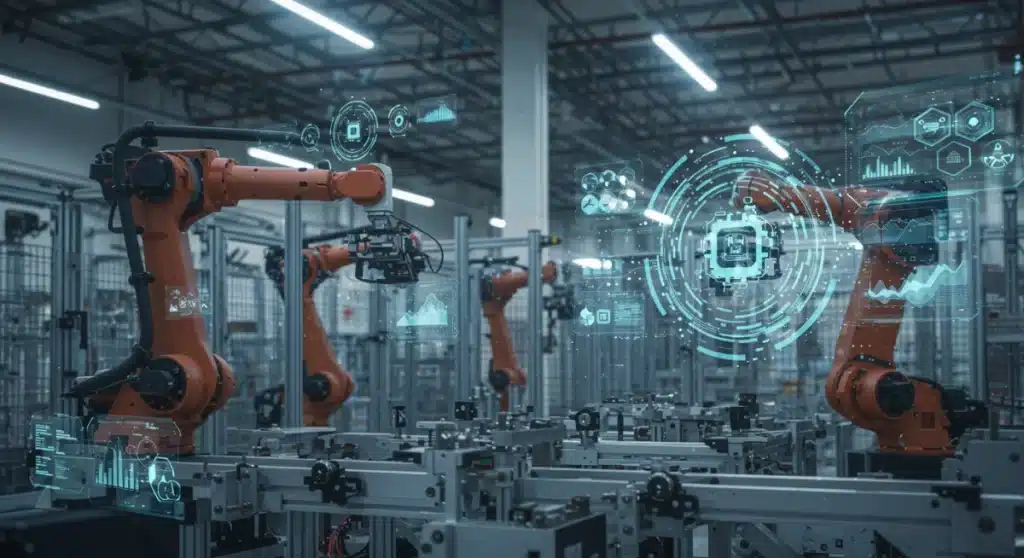
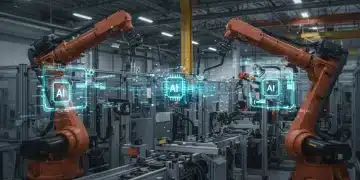
The landscape of US Manufacturing: Robotics & AI is undergoing a radical shift as industrial leaders race toward a 25% efficiency surge by 2026. This isn’t just a goal; it’s a structural rebirth of the American factory floor.
Advanced automation and cognitive computing are no longer experimental, with organizations like the NAM reporting record investments. These smart systems are modernizing assembly lines to maximize output while drastically minimizing resource waste.
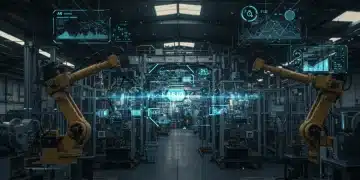
By synchronizing autonomous machinery with predictive intelligence, the industry is redefining global competitiveness. This strategic evolution ensures that domestic production remains agile, resilient, and ready for a hyper-automated future.
The Urgency of Automation in US Manufacturing
The manufacturing sector in the United States faces persistent challenges, including labor shortages, rising operational costs, and intense global competition. These factors underscore the critical need for advanced automation solutions.
Robotics and AI offer a viable pathway to address these pressures, providing solutions that enhance productivity, improve product quality, and reduce the dependency on manual labor for repetitive tasks.
This strategic adoption is becoming a cornerstone of industrial resilience.
Industry leaders and policymakers recognize that embracing these technologies is no longer optional but essential for the sector’s long-term viability and growth. The goal is to create a more agile, efficient, and competitive manufacturing ecosystem.
Addressing Labor Shortages with Robotics
One of the most pressing issues in US manufacturing is the widening skills gap and a shrinking labor pool. Robotics provides a direct solution by automating tasks that are difficult, dangerous, or monotonous for human workers.
This shift allows existing human talent to be reallocated to higher-value activities, such as design, programming, and maintenance of advanced systems. It also opens new avenues for workforce development in specialized technical roles.
Companies are investing heavily in collaborative robots (cobots) that work alongside human employees, augmenting their capabilities rather than replacing them entirely. This symbiotic relationship fosters a more productive and safer work environment.
- Robots handle repetitive, high-volume tasks.
- Human workers focus on complex problem-solving and innovation.
- Cobots improve safety by taking over hazardous operations.
- Training programs are emerging for new roles in automation management.
AI’s Role in Predictive Maintenance and Quality Control
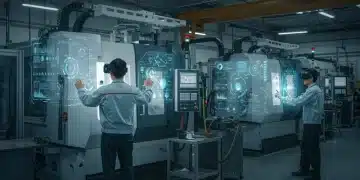
Artificial intelligence is revolutionizing maintenance protocols and quality assurance in manufacturing. AI-powered systems can analyze vast amounts of data from sensors on machinery to predict potential failures before they occur.
This predictive maintenance significantly reduces downtime, extends equipment lifespan, and lowers maintenance costs. It transforms reactive repair into proactive asset management, ensuring continuous production flow.
Furthermore, AI algorithms are becoming indispensable in quality control, identifying defects with greater speed and accuracy than human inspection. This leads to higher product consistency and reduced waste from faulty items.
The integration of AI in these critical areas is a major driver towards achieving the ambitious 25% efficiency gain. It ensures that production lines operate at peak performance with minimal interruptions.
Strategic Investments and Government Initiatives
The commitment to enhancing US Manufacturing: Robotics & AI capabilities is evident in both private sector investments and supportive government policies. These concerted efforts are critical for accelerating technological adoption.
Major corporations are channeling significant capital into R&D and the deployment of advanced automation solutions. This influx of funding is fueling innovation and driving the development of next-generation manufacturing processes.
Concurrently, federal and state governments are initiating programs and incentives designed to encourage manufacturers, especially small and medium-sized enterprises (SMEs), to embrace robotics and AI. These initiatives aim to democratize access to cutting-edge technology.
The National Institute of Standards and Technology (NIST) is actively involved in developing standards and testing protocols for advanced manufacturing technologies. This work ensures interoperability and reliability of new systems.
According to a recent report by the Department of Commerce, federal grants and tax credits are playing a pivotal role in de-risking investments for manufacturers. These incentives are particularly beneficial for companies navigating the initial costs of technological transitions.
For instance, the CHIPS and Science Act includes provisions that support research and development in areas critical to advanced manufacturing, fostering an environment ripe for innovation and growth. These legislative efforts signify a long-term commitment to industrial modernization.
Technological Advancements Driving Efficiency
Recent breakthroughs in robotics and AI are directly contributing to the feasibility of achieving a 25% efficiency gain in US manufacturing. These advancements span various domains, from hardware to sophisticated software algorithms.
Improved sensor technology, enhanced machine vision systems, and more agile robotic manipulators are enabling robots to perform increasingly complex tasks with greater precision and adaptability. These innovations are expanding the scope of automation.
On the AI front, advancements in machine learning, deep learning, and reinforcement learning are empowering systems to learn from data, optimize processes autonomously, and make real-time decisions on the factory floor. This cognitive capability is transformative.
The Rise of Collaborative Robotics
Collaborative robots, or cobots, represent a significant leap forward in automation. Designed to work safely alongside human employees, cobots are flexible, easy to program, and can be quickly redeployed for different tasks.
Their ability to share workspaces with humans without extensive safety caging makes them ideal for tasks requiring both human dexterity and robotic precision. This synergy optimizes workflows and enhances overall productivity.
Cobots are particularly beneficial for SMEs, offering an affordable entry point into automation without requiring a complete overhaul of existing factory layouts. This accessibility accelerates the adoption of advanced robotics across a broader spectrum of manufacturers.
- Cobots enhance human capabilities on the production line.
- They offer flexibility for diverse manufacturing tasks.
- Easier integration reduces initial setup costs and complexity.
- Improved safety features allow for close human-robot interaction.
AI-Powered Supply Chain Optimization
Beyond the factory floor, AI is transforming supply chain management, a critical component of manufacturing efficiency. AI algorithms can analyze market demand, predict potential disruptions, and optimize logistics routes.
This intelligent optimization leads to reduced inventory costs, faster delivery times, and improved responsiveness to market changes. A more resilient and efficient supply chain directly contributes to overall manufacturing productivity.
Companies are leveraging AI to manage raw material procurement, production scheduling, and distribution networks with unprecedented accuracy. This holistic approach ensures that every stage of the manufacturing process is streamlined for maximum efficiency.
The ability of AI to process and interpret vast datasets allows for predictive insights that were previously unattainable. This translates into more informed decision-making and a more robust supply chain.
Challenges and Overcoming Barriers to Adoption
Despite the clear benefits, the widespread integration of robotics and AI in US manufacturing faces several significant challenges. These include high initial investment costs, the need for a skilled workforce, and concerns about job displacement.
Overcoming these barriers requires a multi-faceted approach involving financial incentives, comprehensive training programs, and transparent communication strategies. Addressing these issues is crucial for successful implementation.
The perceived complexity of integrating new technologies can also deter smaller manufacturers. Simplification of deployment processes and the availability of expert support are vital for broader adoption.
Workforce Reskilling and Education
The transition to an AI- and robotics-driven manufacturing environment necessitates a substantial investment in workforce reskilling and education. Existing employees need to acquire new competencies to operate, maintain, and program advanced systems.
Educational institutions, vocational schools, and industry associations are collaborating to develop curricula that meet the demands of the modern factory. These programs are essential for ensuring a smooth technological transition.
Companies are also implementing internal training programs to upskill their employees, transforming traditional roles into more technologically advanced positions. This proactive approach helps mitigate concerns about job losses and fosters a culture of continuous learning.
- New training programs focus on robotics and AI operation.
- Vocational schools are updating their curricula.
- Companies invest in internal upskilling initiatives.
- Emphasis on human-robot collaboration skills.
Cybersecurity Concerns in Automated Environments
As manufacturing systems become more interconnected and data-driven, cybersecurity emerges as a critical concern. Automated factories are vulnerable to cyberattacks that could disrupt production, compromise intellectual property, or damage critical infrastructure.
Protecting these advanced systems requires robust cybersecurity protocols, continuous monitoring, and employee training on best practices. Manufacturers must prioritize security as an integral part of their digital transformation strategy.
The US government, through agencies like the Cybersecurity and Infrastructure Security Agency (CISA), is providing guidance and resources to help manufacturers secure their operational technology (OT) environments.
This collaborative effort is essential for safeguarding the future of manufacturing.
The integrity of data flowing through AI systems is also paramount. Ensuring data privacy and preventing manipulation are crucial for maintaining trust in automated decision-making processes.
Economic Impact and Global Competitiveness
Achieving a 25% efficiency gain in US Manufacturing: Robotics & AI integration by 2026 holds profound implications for the national economy and global competitiveness.
Increased efficiency translates directly into higher productivity and reduced production costs.
This enhanced competitiveness will allow US manufacturers to better compete with international counterparts, potentially leading to a resurgence in domestic production and job creation in high-skill areas. The economic ripple effects are expected to be substantial.
Analysts project that a more efficient manufacturing sector will contribute significantly to GDP growth, attract further foreign investment, and strengthen the nation’s economic resilience against global supply chain shocks. The strategic importance cannot be overstated.
The adoption of advanced manufacturing techniques also fosters innovation, positioning the US as a leader in industrial technology. This leadership will have long-term benefits for various economic sectors.
Case Studies: Early Adopters and Success Stories
Several US manufacturers have already begun to successfully integrate robotics and AI, providing tangible evidence of the potential for significant efficiency gains. These early adopters serve as models for broader industry transformation.
Companies in industries ranging from automotive to aerospace and consumer goods are reporting substantial improvements in productivity, quality, and cost reduction. Their experiences offer valuable insights into effective implementation strategies.
These success stories highlight the importance of starting with clear objectives, investing in workforce training, and fostering a culture of innovation. The lessons learned are critical for others embarking on similar journeys.
Automotive Sector’s Leap in Automation
The automotive industry has historically been at the forefront of manufacturing automation, and it continues to lead the way in integrating advanced robotics and AI. Major US automakers are deploying sophisticated systems for assembly, painting, and quality inspection.
For example, companies are using AI-powered vision systems to detect minute defects in vehicle bodies with unprecedented accuracy, ensuring higher quality standards. Robotic arms perform intricate assembly tasks with speed and consistency.
These innovations have not only improved efficiency but also enhanced worker safety by automating hazardous processes. The automotive sector’s continuous evolution provides a blueprint for other industries.
- Robots handle complex assembly and welding tasks.
- AI vision systems ensure stringent quality control.
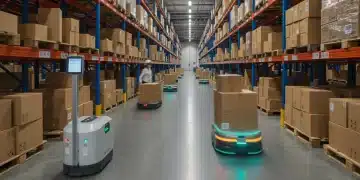
- Automated guided vehicles (AGVs) optimize material flow.
- Data analytics drives continuous process improvement.
Aerospace and Defense Leveraging AI for Precision
The aerospace and defense sector, with its stringent requirements for precision and reliability, is heavily investing in AI and robotics. These technologies are crucial for manufacturing complex components and ensuring the integrity of critical systems.
AI is used for generative design, optimizing component structures for strength and weight, while advanced robotics perform precise machining and assembly of intricate parts. The level of accuracy achieved is unmatched by manual processes.
Furthermore, AI-driven simulations are used to test designs and manufacturing processes virtually, reducing the need for expensive physical prototypes and accelerating product development cycles. This strategic adoption is critical for national security and technological superiority.
The benefits extend to maintenance, where AI predicts component lifespan and schedules proactive interventions, ensuring operational readiness of aircraft and defense systems. This precise application of technology is vital for the sector’s demands.
The Road Ahead: 2026 and Beyond
The target of a 25% efficiency gain by 2026 through US Manufacturing: Robotics & AI integration is an ambitious yet achievable goal. The foundation for this transformation is being laid now, with significant momentum building across the industry.
Beyond 2026, the evolution of manufacturing is expected to continue at an accelerated pace, driven by emerging technologies such as quantum computing, advanced materials, and enhanced human-robot interfaces. The future promises even greater levels of automation and intelligence.
The ongoing commitment from industry, academia, and government will be crucial in navigating future challenges and maximizing the benefits of these technological advancements. Continuous innovation and adaptation will define success.
The long-term vision is a resilient, highly efficient, and globally competitive US manufacturing sector that serves as a cornerstone of economic prosperity and national security. This journey is just beginning.
| Key Aspect | Brief Description |
|---|---|
| Efficiency Goal | Target of 25% gain by 2026 through robotics and AI. |
| Key Technologies | Robotics, Artificial Intelligence, and automation systems. |
| Drivers of Change | Labor shortages, global competition, and operational costs. |
| Economic Impact | Enhanced competitiveness, GDP growth, and high-skill job creation. |
Frequently Asked Questions About US Manufacturing Automation
The efficiency goal is driven by the need to address labor shortages, mitigate rising operational costs, and enhance global competitiveness. Integrating robotics and AI offers solutions to these persistent challenges, leading to more streamlined production processes and higher output.
Robotics automates repetitive and hazardous tasks, freeing human workers for complex roles. AI optimizes processes through predictive maintenance, enhanced quality control, and intelligent supply chain management. Together, they minimize downtime and maximize resource utilization.
Key challenges include the high initial investment costs for new equipment, the necessity for a skilled workforce to operate and maintain these systems, and concerns regarding job displacement. Cybersecurity also poses a significant risk in interconnected manufacturing environments.
The US government provides support through grants, tax credits, and initiatives like the CHIPS and Science Act. These programs incentivize R&D and technology adoption, while agencies like NIST develop standards to ensure system interoperability and reliability.
Increased automation is projected to boost national GDP, enhance global competitiveness for US manufacturers, and foster the creation of high-skill jobs in technology and engineering. It also strengthens economic resilience against supply chain disruptions.
What this means
The strategic imperative for US Manufacturing: Robotics & AI integration is clear, with the 25% efficiency gain by 2026 serving as a critical benchmark.
This ongoing transformation signifies a profound reorientation of industrial practices, moving towards a future defined by technological sophistication and operational excellence.
Stakeholders must continue to monitor policy developments, technological breakthroughs, and workforce training initiatives.
The success of this endeavor will not only determine the future of American manufacturing but also its standing in the global economy, demanding continuous adaptation and forward-thinking investment.