AI in Healthcare: Automating Administrative Tasks to Save 20% in U.S. Hospitals

The rise of AI in Healthcare is no longer a future concept; it is currently revolutionizing how U.S. hospitals manage their daily operations. By integrating intelligent systems into back-office workflows, medical centers are unlocking unprecedented levels of efficiency.
These smart automation tools target the heavy burden of manual documentation and insurance processing that often slows down patient care. Streamlining these administrative cycles allows providers to recapture nearly a fifth of their traditional operational budgets.
This technological shift is essential for modern health systems aiming to combat burnout and financial waste. Monitoring how these digital assistants evolve will be crucial as the industry moves toward a more sustainable and tech-driven fiscal model.
The Imperative for AI in Healthcare Automation
U.S. hospitals face mounting pressure to reduce operational costs while simultaneously improving patient care and staff satisfaction. Administrative burdens often consume a significant portion of budgets and staff time, diverting resources from critical clinical functions.
The integration of advanced artificial intelligence (AI) solutions into healthcare administration offers a tangible pathway to alleviate these challenges.
By automating repetitive and time-consuming tasks, AI promises a substantial reduction in overheads and a reorientation of human capital towards more impactful roles.
Industry analysts and healthcare executives are increasingly recognizing the transformative potential of AI in Healthcare Automation.
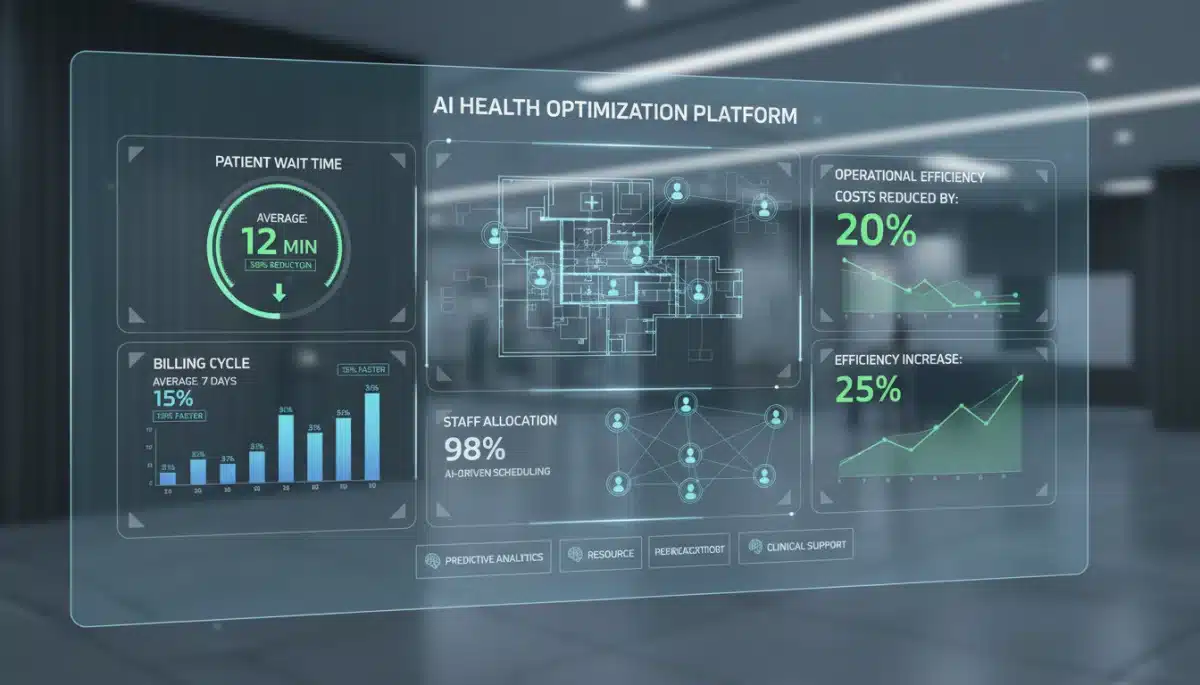
Projections suggest that widespread adoption could yield savings upwards of 20% in operational costs for U.S. hospitals, marking a pivotal shift in the sector’s financial health and efficiency.
Understanding the Scope of Administrative Tasks in Healthcare
Administrative tasks in U.S. hospitals encompass a vast array of activities, from patient registration and scheduling to billing, coding, and claims processing.
These processes are inherently complex, often requiring meticulous attention to detail and adherence to stringent regulatory frameworks.
The sheer volume of paperwork and data entry involved in these tasks contributes significantly to operational inefficiencies and potential errors.
Staff spend countless hours on manual data reconciliation, appointment management, and insurance verification, which can lead to burnout and reduced productivity.
Effectively addressing these administrative bottlenecks is critical for hospitals striving for financial stability and improved service delivery. AI offers a scalable and precise solution to streamline these operations, directly impacting the bottom line through enhanced efficiency.
Key Areas Where AI Drives Cost Savings
AI in Healthcare Automation demonstrates immense potential across several administrative domains, each contributing to substantial cost reductions.
Automating patient intake and scheduling systems, for instance, minimizes human error and reduces wait times, improving patient experience and operational flow.
In the realm of medical coding and billing, AI-powered tools can accurately assign codes, scrutinize claims for discrepancies, and expedite payment cycles. This not only reduces the likelihood of denied claims but also frees up skilled personnel for more complex financial oversight roles.
Automated Patient Management
AI-driven chatbots and virtual assistants are revolutionizing patient interactions by handling inquiries, scheduling appointments, and providing pre-visit instructions.
This reduces the workload on administrative staff, allowing them to focus on more critical patient needs and complex cases.
Furthermore, these AI systems can personalize patient communication, send automated reminders, and collect demographic information efficiently. The result is a smoother patient journey and a significant reduction in administrative overhead associated with manual communication.
Optimizing Revenue Cycle Management
Revenue cycle management (RCM) is a prime candidate for AI intervention, given its data-intensive nature and direct impact on hospital finances. AI algorithms can analyze vast datasets to identify patterns, predict payment likelihoods, and flag potential billing errors before they occur.
This proactive approach minimizes revenue leakage, accelerates claim submissions, and improves collections rates.
By automating tasks like charge capture, claims scrubbing, and denial management, hospitals can achieve greater financial stability and unlock significant savings.
- AI-powered coding accuracy reduces claim denials.
- Predictive analytics optimize payment collections.
- Automated claims processing accelerates revenue cycles.
Implementation Challenges and Strategic Solutions
While the benefits of AI in Healthcare Automation are clear, successful implementation is not without its challenges.
Hospitals must navigate issues such as data privacy and security, integrating new AI platforms with legacy systems, and ensuring staff adoption and training.
Addressing these hurdles requires a strategic, phased approach that prioritizes data governance, interoperability, and robust change management. Engaging clinical and administrative staff early in the process is crucial to fostering acceptance and identifying practical applications.
Investing in scalable AI infrastructure and establishing clear performance metrics are also vital for demonstrating ROI and sustaining long-term success. Collaboration with experienced AI vendors and cybersecurity experts can mitigate risks and accelerate deployment.
The Role of Data and Interoperability in AI Success
The efficacy of AI in Healthcare Automation relies heavily on access to high-quality, standardized data. Hospitals generate enormous volumes of data daily, but often this information resides in disparate systems, limiting its utility for AI applications.
Achieving true interoperability between various health information systems (HIS), electronic health records (EHR), and administrative platforms is paramount.
This allows AI algorithms to draw comprehensive insights and automate processes across the entire hospital ecosystem.
Robust data governance policies, including strict adherence to HIPAA regulations and data anonymization techniques, are essential to build trust and ensure compliance. Without a solid data foundation, AI’s potential remains largely untapped, hindering significant cost savings.
Measuring the 20% Cost Reduction Target
The ambitious target of saving 20% in operational costs through AI in Healthcare Automation is not a hypothetical figure; it is based on analyses of administrative spend and the proven efficiencies of AI in other sectors.
This reduction can be realized through various direct and indirect mechanisms.
Direct savings stem from reduced labor costs due to automation, fewer errors leading to costly rework, and optimized resource allocation.
Indirect savings include improved patient satisfaction, which can lead to higher retention and better outcomes, ultimately reducing readmissions and associated expenses.
Hospitals are advised to establish clear baselines for administrative costs before AI implementation and continuously monitor key performance indicators (KPIs) post-deployment.
This data-driven approach ensures that the impact of AI is accurately measured and further optimizations can be made.
Case Studies and Early Adopters
Several U.S. hospitals and health systems have already begun implementing AI solutions for administrative tasks, reporting promising early results. These pioneers are demonstrating tangible improvements in efficiency, staff workload, and financial performance.
For example, some institutions have seen reductions in patient no-show rates by leveraging AI for personalized reminders and rescheduling. Others have significantly cut down on the time and resources spent on prior authorizations through intelligent automation.
- Large health systems report 15% reduction in billing errors.
- Community hospitals decrease patient check-in times by 30%.
- Academic medical centers save thousands annually on transcription services.
Future Outlook: Expanding AI’s Footprint in Hospital Operations
The trajectory for AI in Healthcare Automation suggests an expanding role beyond current applications. As AI technologies mature and become more sophisticated, they will likely integrate into more complex decision-making processes within hospital administration.
Predictive analytics, for instance, could optimize staffing levels based on anticipated patient volumes, minimizing understaffing or overstaffing.
AI might also play a larger role in supply chain management, forecasting demand and automating procurement to reduce waste and costs.
The evolution of AI will also necessitate ongoing adaptation from healthcare providers, including continuous training for staff and investment in emerging technologies. The ultimate goal remains to create a more resilient, efficient, and patient-centered healthcare system.
| Key Point | Brief Description |
|---|---|
| Cost Savings Potential | AI can save U.S. hospitals up to 20% in operational costs by automating administrative tasks. |
| Administrative Efficiency | Automation targets patient registration, billing, coding, and scheduling, reducing manual effort. |
| Key Benefits | Improved accuracy, faster processes, reduced staff burnout, and enhanced patient experience. |
| Implementation Focus | Requires data interoperability, strong security, and effective change management for success. |
Frequently Asked Questions About AI in Healthcare Automation
AI automates repetitive and data-intensive tasks such as patient scheduling, appointment reminders, insurance verification, medical coding, and claims processing. It also handles initial patient inquiries through chatbots and assists with electronic health record (EHR) data entry and reconciliation.
Industry analyses project that AI in healthcare automation can lead to savings of up to 20% in operational costs for U.S. hospitals. These savings are realized through increased efficiency, reduced errors, and optimized resource allocation, directly impacting the hospital’s financial health.
Key challenges include ensuring data privacy and security (HIPAA compliance), integrating AI systems with existing legacy infrastructure, and managing staff resistance to new technologies. Overcoming these requires careful planning, robust data governance, and comprehensive training programs.
The goal of AI in healthcare automation is not to replace human staff but to augment their capabilities and free them from mundane tasks. This allows administrative professionals to focus on more complex problem-solving, patient interaction, and strategic initiatives that require human judgment and empathy.
Data quality is absolutely critical for effective AI automation. AI algorithms rely on accurate, consistent, and comprehensive data to learn and perform tasks efficiently. Poor data quality can lead to erroneous outputs, undermining the benefits of AI and increasing the risk of adverse outcomes.
Looking Ahead: The Evolving Landscape of AI in Healthcare
The ongoing integration of AI in Healthcare Automation represents a significant evolutionary step for U.S. hospitals, moving towards a more efficient and patient-centric operational model.
The projected 20% savings in administrative costs are not merely a financial metric but a testament to AI’s capacity to reshape the delivery of care.
As AI technologies continue to advance, their applications will broaden, influencing everything from predictive maintenance of medical equipment to personalized patient outreach.
This continuous evolution demands that healthcare leaders remain agile, adaptable, and committed to leveraging innovation.
The journey towards fully optimized healthcare administration through AI is dynamic, requiring sustained investment, strategic partnerships, and a human-centered approach to technology adoption.
The future promises a healthcare system where administrative burdens are significantly reduced, allowing for greater focus on what truly matters: patient well-being.